Description and Operation
Rear Axle - M250 (2021 - Present)
▸Contents: 03 - Differential and Driveline
Description and Operation
Diagnosis and Testing
ASSEMBLY, Differential
Disassembly and Assembly
Actuator/Motor
GEAR, Ring and Pinion
Removal and Installation
Joints
SHAFTS, Axle/Drive/Half
Valves
Removal and Installation
 |
DESCRIPTION
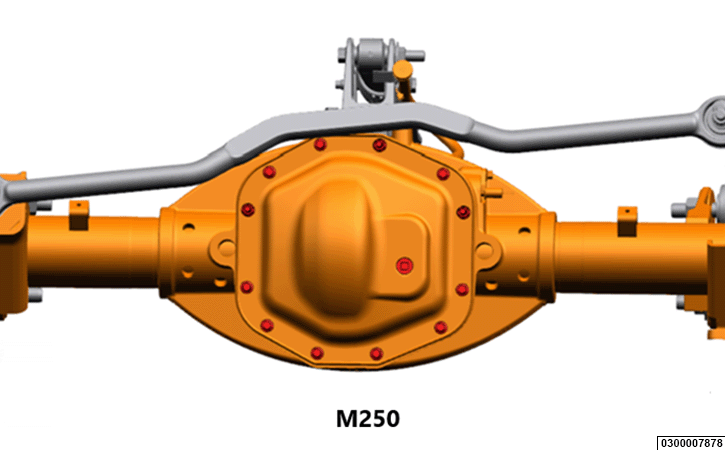
The M250 axle is used in extreme performance 4WD trucks only beginning in the 2021 model year. The M250 rear axle housing has a cast iron center section with steel axle tubes. The housing contains the differential, ring and pinion gears, the axle shafts and associated bearing and seals. The M250 has full floating axle shafts, the axle shafts transmit torque only and do not support any vehicle weight.
The rear axle is mounted in the vehicle via the rear suspension, and is affixed via the rear shock absorbers and the rear upper and lower control arms. A track bar is mounted behind the rear axle and is position laterally between the axle housing and the frame. The track bar has rubber/urethane bushings at each end. The track bar keeps the rear axle centered in relation to the vehicles frame.
The M250 rear axle is equipped with an electronic locking differential which when engaged, locks the rear axles together, eliminating any allowance for differing wheel speeds. When the electronic locker is disengaged, the differential will allow for different wheel speeds when negotiating a turn the same as an open differential. The Electronic locking differential is turned on and off by the operator with a switch in the cab. The system defaults to off (unlocked) when the key is cycled.
OPERATION
Torque is provided to the axle form the powertrain to the pinion gear via the driveshaft. The pinion gear is supported by two tapered bearings and drives the ring gear, which is bolted to the differential case. The differential case is also supported by two tapered bearings. Within the differential case, there are two differential pinion gears and two side gears which are in constant mesh. When the differential case is being driven, the two differential pinion gears are turning because they are mounted on a shaft that is anchored to the differential case. The two pinion gears then transfer torque to the two side gears, which are splined to the axle shafts. When traveling in a straight line, with no variation in rear wheel speed, the differential pinion gears are turning with the differential case, but not spinning on the pinion shaft. Because the differential pinion gears are not spinning on the shaft, they transfer torque equally to both axles.
- When a wheel speed difference exists with an open differential:
- When negotiating a turn the wheel on the inside of the turn rotates at a slower speed than the wheel on the outside of a turn. The wheel speed difference causes the pinion gears to rotate around the pinion shaft and transfers more torque to the wheel on the outside of the turn. This allows the wheels to turn at different speeds smoothly. The wheel speed difference increases with the sharpness of the turn, the tighter the turn, the faster the pinion gears will rotate.
- When operating in a straight line in a low traction environment with one wheel having less traction than the other wheel, the differential functions much the same was when the vehicle is in a turn. In this situation, the wheel speed difference will cause the pinion gears to rotate, transferring more torque to the wheel with the least amount of traction. This is a normal characteristic of an open differential which is not desirable in many low traction environments.
- When a condition exists that should induce a wheel speed difference with Electric Locking Differential:
- When negotiating a turn on a hard surface, the electronic locking differential, when engaged, will not allow a wheel speed difference to exist. This will cause an unstable operating condition, as both rear wheels will have the same amount of torque to be available at all times. This will cause the wheel on the inside of the turn to want to spin or “slip”, and cause the vehicle to resist turning. The electronic locking differential should NOT be engaged when operating on the road in almost all cases.
- When negotiating a turn on a limited traction surface, the wheel on the inside of the turn will spin or “slip”, due to the low traction surface. If the traction varies, the more traction that is available, the more the vehicle will resist turning.
- When operating in a straight line in a low traction environment the electronic locking differential always transmits equal torque to both rear wheels when engaged.